If you’re traveling to France, the AOP label is your shortcut to the real thing. AOP France labels, along with AOC, IGP and Label Rouge, tell you where a food comes from and how it was made. But in a busy market, they can look like a confusing alphabet soup.
This guide explains what each label means, introduces five protected foods worth seeking out, and gives you the French phrases to ask for them at a marché (“market”) or fromagerie (“cheese shop”).
AOP France: Quick Reference
THE TOP LABEL
The rule to remember
AOP / AOC = where and how it’s made. IGP = where, at least partly. Label Rouge = how good it is, not where it’s from.
The four labels at a glance
| Label | Stands for | What it guarantees |
|---|---|---|
| AOP | Appellation d’origine protégée | Every step happens in one area, using traditional know-how (EU label) |
| AOC | Appellation d’origine contrôlée | The French national version of AOP, mostly seen on wine |
| IGP | Indication géographique protégée | At least one step happens in the region |
| Label Rouge | “Red Label” | Higher quality than the standard product; not about origin |
Golden rule: always start with Bonjour Madame or Bonjour Monsieur before you ask for anything.
Table of Contents
- The 4 Labels You’ll See Everywhere
- Phrases to Ask for These Foods
- At the Fromagerie: Sara Goes Cheese Shopping
- 5 Protected Foods Worth Seeking Out
- Reading the Label Fast
- Common Mix-Ups Travelers Make
- Quiz: Are You Ready for the Market?
- AOP France FAQ
- Final Thoughts
1. The 4 Labels You’ll See Everywhere
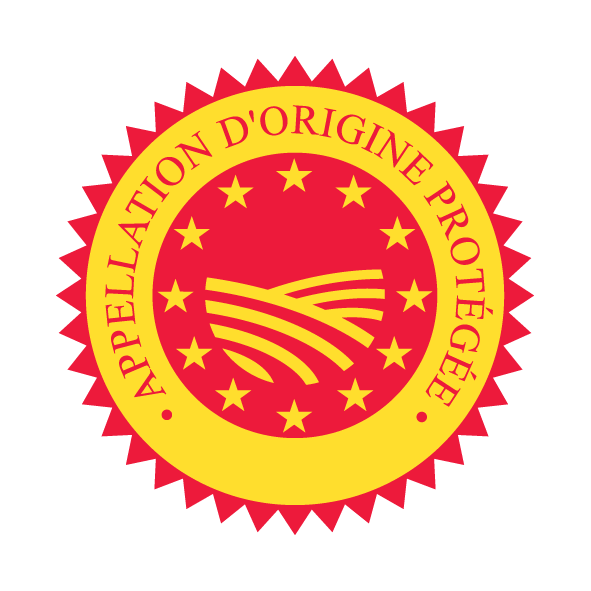
Photo: “Protected-designation-origin-logo-fr” by European Commission, Public domain, via Wikimedia Commons
Think of these labels as a guarantee of authenticity. Here’s how to tell them apart:
- AOP (Appellation d’origine protégée): the top tier, and the EU-wide label (“PDO” in English). The food must be produced, processed and prepared entirely in one geographical area, using recognized traditional know-how. Look for the red-and-yellow logo.
- AOC (Appellation d’origine contrôlée): the French national label that came first. Today you’ll mostly see it on wine, and on some foods while they wait for EU AOP status. It offers the same kind of guarantee.
- IGP (Indication géographique protégée): “PGI” in English. At least one stage of production, processing or preparation must happen in the region. It’s more flexible than AOP but still ties the product to a place. Its logo is blue and yellow.
- Label Rouge (“Red Label”): a French quality label. It’s not about geography: it guarantees higher quality than the standard product (for example, slower-growing, free-range chickens). Some products, often IGP poultry, carry both an origin label and Label Rouge.
étiquette – label
Why these labels exist: France set up its appellation system in the 1930s, first for wine, to protect regional products from fraud and imitation. The labels preserve traditional savoir-faire (“know-how”) and the terroir, the unique character a place gives a food. Today they’re managed by the INAO, France’s national institute for origin and quality.
2. Phrases to Ask for These Foods

Photo: “Pezenas Market – Cheese stall” by Dave (resting) from Newcastle, UK, CC BY-SA 2.0, via Wikimedia Commons
marché – market
Vendors are usually passionate about their products and happy to help. Always start with Bonjour Madame or Bonjour Monsieur, then use these:
| French | English |
|---|---|
| Je voudrais 200 grammes de comté, s’il vous plaît. | I’d like 200 grams of Comté, please. |
| C’est un fromage AOP ? | Is this an AOP cheese? |
| Qu’est-ce que vous me conseillez ? | What do you recommend? |
| C’est de quelle région ? | Which region is this from? |
| Je peux goûter ? | Can I taste it? |
| Pouvez-vous répéter, s’il vous plaît ? | Can you repeat that, please? |
Je veux un peu de fromage. – I want a little cheese.
Practice a full market conversation in Go Shopping at a Traditional French Market.
3. At the Fromagerie: Sara Goes Cheese Shopping
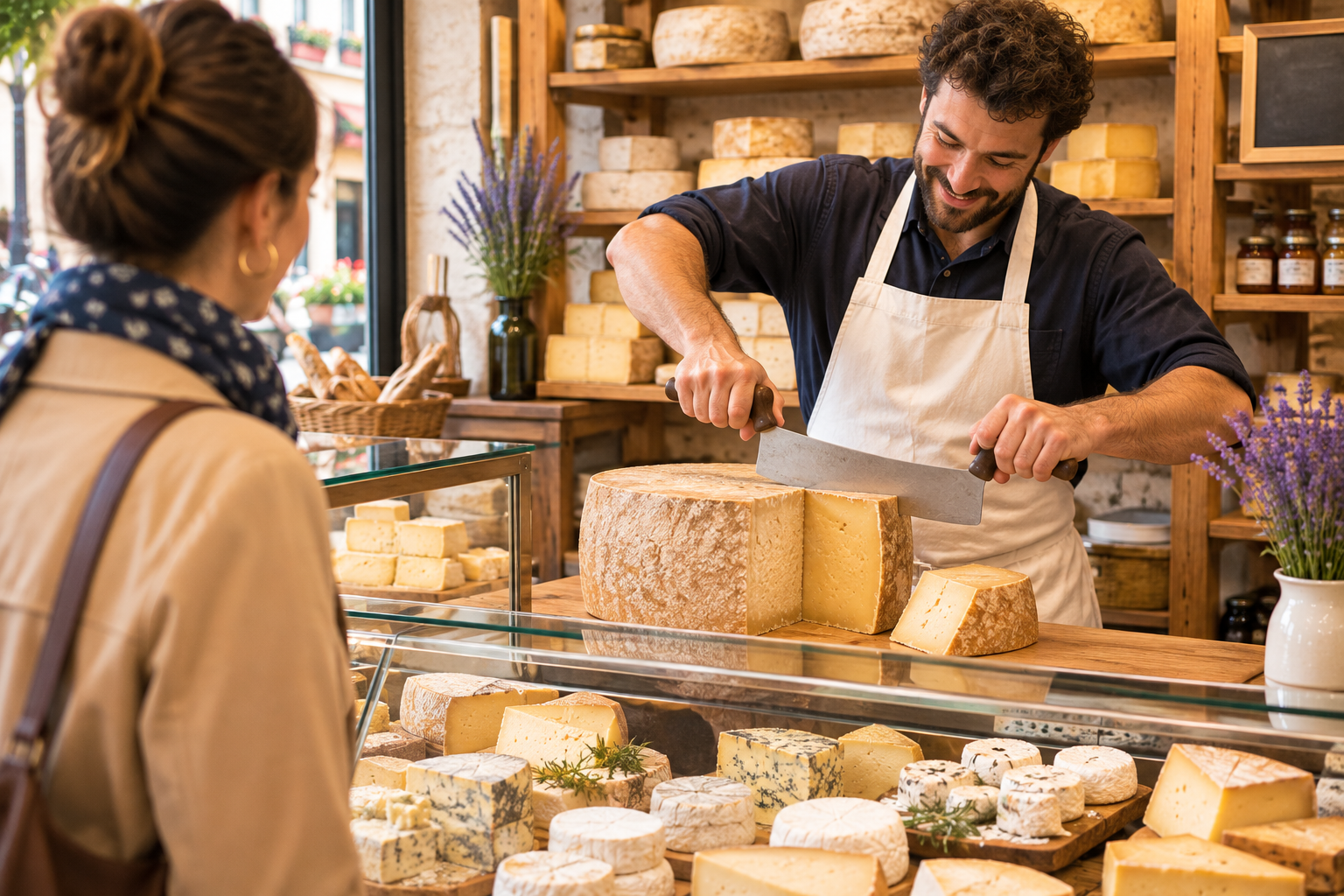
fromagerie – cheese shop
Getting stuck on a word is normal. If it happens, just say Pouvez-vous répéter, s’il vous plaît ? or Qu’est-ce que ça veut dire ? (“What does that mean?”).

Want to hear real market French? In the video lesson The Saturday Market (Food & Origins), Victor and his mother shop at a covered market in Reims and talk about where their food comes from.
Hear French the way locals speak it
Watch the video lesson and train your ear for market conversations before your trip to France.
Watch the Lesson4. 5 Protected Foods Worth Seeking Out
Having a specific goal makes shopping easier. Here are five iconic protected products, with a rough pronunciation guide. Use the audio where you see it to hear a native speaker.
Comté AOP (Franche-Comté)

Photo: “Comte AOP” by Myrabella, CC BY-SA 3.0, via Wikimedia Commons
This beloved hard cheese comes from the Jura mountains in Franche-Comté, eastern France. It’s made from the raw milk of Montbéliarde (and Simmental) cows and aged for at least four months, often much longer. Its flavor is nutty, slightly sweet and complex. Say it like “kon-TAY.”
Roquefort AOP (Aveyron)

Photo: “Wikicheese – Roquefort” by Thesupermat, CC BY-SA 4.0, via Wikimedia Commons
The king of blue cheeses. Roquefort is made from sheep’s milk and ripened in the natural caves of Roquefort-sur-Soulzon, in the Aveyron department of southern France. It’s intense, tangy and creamy. Say it like “rok-FOR.”
Camembert de Normandie AOP (Normandy)

Photo: “Camembert de Normandie (AOP)” by Coyau, CC BY-SA 3.0, via Wikimedia Commons
camembert – Camembert
Real Camembert de Normandie is a soft, bloomy-rind cheese made with raw cow’s milk in Normandy. It has a rich, earthy, mushroomy flavor that the mass-produced versions can’t match. Check for the full name: just “Camembert” isn’t protected.
Volaille de Bresse AOP (Bresse)

Photo: “Poulet de Bresse – Gauloise Blanche” by CIVB – Volaille de Bresse, CC BY-SA 4.0, via Wikimedia Commons
poulet – chicken
Often called the best chicken in the world, volaille de Bresse comes from the Bresse area in eastern France, mainly in the Ain department. The birds are raised free-range on grass and finished on a cereal-and-milk diet, which gives them their famous flavor and texture.
Pruneaux d’Agen IGP (Lot-et-Garonne)

Photo: “Séchage des pruneaux” by Paternel 1, CC BY-SA 4.0, via Wikimedia Commons
pruneau – prune
These aren’t ordinary prunes. Pruneaux d’Agen are made from the prune d’Ente plum, grown around the town of Agen in southwestern France, then dried and rehydrated to be soft, sweet and juicy. Say it like “proo-NO dah-ZHEN.”
Want more classic dishes? See Top 5 French Foods.
5. Reading the Label Fast
In a busy shop, you have a few seconds to choose. Check these three things:
- Spot the logo: the red-and-yellow AOP stamp or the blue-and-yellow IGP stamp, usually on the packaging or the cheese rind.
- Check the full name: the label gives the protected name. That’s how you tell a generic brie from an authentic Brie de Meaux AOP.
- Look for Label Rouge separately: on poultry, meat or eggs, the red logo means higher quality, not a specific region.
qualité – quality
6. Common Mix-Ups Travelers Make
- Thinking Label Rouge means local: it doesn’t. Label Rouge guarantees quality, not origin. For a regional specialty, look for an AOP or IGP name as well.
- Ordering by piece instead of by weight: cheese is usually sold by weight: deux cents grammes, s’il vous plaît. For pâté or a small goat cheese, ask for une tranche (“a slice”) or une pièce (“one piece”).
- Assuming the short name is protected: “Camembert” or “brie” alone are just styles. The protected product is the full name, like Camembert de Normandie.
gramme – gram
7. Quiz: Are You Ready for the Market?
Ready for the market? Tap an answer to see if you’re right.
Question 1. Which label tells you a food was made entirely in one region, the traditional way?
Question 2. A chicken has a Label Rouge. What does that tell you?
Question 3. Where does Roquefort come from?
Question 4. How do you ask “Which region is this from?”
Question 5. You want 200 grams of Comté. What do you say?
8. AOP France FAQ
What does AOP mean in France?
AOP stands for appellation d’origine protégée, the French name for the EU’s Protected Designation of Origin (PDO). It means a food is produced, processed and prepared in one defined area using traditional methods.
What’s the difference between AOP and AOC?
AOC is the French national label that came first; AOP is the European version. Most French foods now carry AOP, while wines still commonly use AOC.
Is Label Rouge the same as organic?
No. Label Rouge guarantees higher quality than the standard product, but it isn’t an organic label. In France, organic products carry the AB (agriculture biologique) logo.
Are all AOP cheeses made with raw milk?
No. Many are, like Comté, Roquefort and Camembert de Normandie, but each AOP has its own rules. Check the label, or ask: C’est au lait cru ? (“Is it made with raw milk?”).
9. Final Thoughts
With AOP France labels decoded, you can shop like a local: look for AOP or IGP for the region, Label Rouge for quality, and don’t be shy about asking C’est de quelle région ? or Je peux goûter ?
Curious about what French people love to eat? Listen to What’s Your Favorite Food to Eat in France?.
Learn French for your next trip
From the market to the restaurant, FrenchPod101 has audio and video lessons from native teachers that prepare you for real conversations in France.
Start Learning for FreeYour turn: which French cheese would you try first? Tell us in the comments, in French if you can!