
Ordering coffee in French? One small verb change can make you sound much more polite.
Instead of Je veux un café (“I want a coffee”), say Je voudrais un café (“I would like a coffee”). That’s the French conditional tense in action.
Once you learn this pattern, you can also give advice, express wishes, and talk about imaginary situations. In this guide, you’ll learn how to form the conditionnel présent, which irregular stems to memorize, when to use it, how it works in si clauses, and which mistakes to avoid. There’s also a quick quiz near the end so you can check what you’ve learned.
French Conditional: Quick Reference
What it means
Usually “would” in English. With pouvoir and devoir, it also gives you “could” and “should.”
How to form it
Future stem + imperfect endings
parler → je parlerais (I would speak)
The six endings
| je | -ais | nous | -ions |
| tu | -ais | vous | -iez |
| il / elle / on | -ait | ils / elles | -aient |
Three examples you can use today
- Je voudrais un café, s’il vous plaît. — I would like a coffee, please.
- Tu devrais prendre un parapluie. — You should take an umbrella.
- Si j’avais le temps, je voyagerais plus. — If I had the time, I would travel more.
Avoid: Never use the conditional right after si (“if”). Say Si j’avais…, not Si j’aurais…
Want the full explanation? Jump to any section below.
Table of Contents
- What Is the French Conditional?
- How to Form the Conditionnel Présent
- Irregular Conditional Stems
- How to Use the Conditional in French
- French Si Clauses: “If” Sentences
- The Past Conditional (Conditionnel Passé)
- Common Mistakes to Avoid
- Test Your French Conditional Knowledge
- French Conditional FAQ
- Final Thoughts
1. What Is the French Conditional?
The French conditional (le conditionnel) usually matches the English word “would.” You use it for things that depend on a condition, things you would like, and situations you’re only imagining.
- Je voyagerais plus souvent. — I would travel more often.
- Nous aimerions venir. — We would like to come.
- Ce serait parfait ! — That would be perfect!
French doesn’t need a separate word for “would.” The meaning is built into the verb ending, so once you know the pattern, it works with almost any verb.
It’s also one of the most useful tenses to learn early. In the lesson How Many Tenses Are There in French?, our teachers explain that French has 22 tenses, but you only need about five for everyday conversation, and the conditionnel présent is one of them. They describe it as “one of the most uncomplicated tenses in French.”
2. How to Form the Conditionnel Présent
Here’s the good news: you already know both building blocks if you’ve studied the future and the imperfect.
- Take the future stem. For most verbs, this is simply the infinitive: parler, finir. For -re verbs, drop the final -e: prendre → prendr-.
- Add the imperfect endings: -ais, -ais, -ait, -ions, -iez, -aient.
The French Conditional Endings in Action
| Pronoun | parler (to speak) | finir (to finish) | prendre (to take) |
|---|---|---|---|
| je | parlerais | finirais | prendrais |
| tu | parlerais | finirais | prendrais |
| il / elle / on | parlerait | finirait | prendrait |
| nous | parlerions | finirions | prendrions |
| vous | parleriez | finiriez | prendriez |
| ils / elles | parleraient | finiraient | prendraient |
Quick check: every conditional form has an r just before the ending. No r? You’ve probably written the imperfect instead.
3. Irregular Conditional Stems
Some common verbs have an irregular stem. The good news is that it’s the same stem they use in the future tense, and the endings never change. These are the ones you’ll use most:
| Infinitive | Stem | Conditional | English |
|---|---|---|---|
| être | ser- | je serais | I would be |
| avoir | aur- | j’aurais | I would have |
| aller | ir- | j’irais | I would go |
| faire | fer- | je ferais | I would do / make |
| pouvoir | pourr- | je pourrais | I could |
| vouloir | voudr- | je voudrais | I would like |
| devoir | devr- | je devrais | I should |
| savoir | saur- | je saurais | I would know |
| venir | viendr- | je viendrais | I would come |
| voir | verr- | je verrais | I would see |
| envoyer | enverr- | j’enverrais | I would send |
| falloir | faudr- | il faudrait | it would be necessary |
A few regular -er verbs also change their spelling, just as they do in the future: acheter → j’achèterais, appeler → j’appellerais, and payer → je paierais (or je payerais).
4. How to Use the Conditional in French

Now that you can form the conditional, here are the five situations where you’ll use it most.
1. Making Polite Requests
This is the use you’ll need first, in cafés, shops, and hotels. The conditional softens a request so it sounds more courteous.
- Je voudrais un café, s’il vous plaît. — I would like a coffee, please.
- Pourriez-vous m’aider ? — Could you help me?
- J’aimerais réserver une table pour deux. — I would like to book a table for two.
In the lesson Saying What You Want in French, FrenchPod101 host Fanny explains the difference: voudrais (“would like”) is the polite way to ask for something, while veux (“want”) is much more direct and can sound too strong with waiters, strangers, or in formal situations. She also shows a handy pattern, Je voudrais + noun + adjective, as in Je voudrais un café fort (“I would like a strong coffee”). Short adjectives of beauty, age, goodness, and size usually go before the noun instead: Je voudrais une belle maison (“I would like a beautiful house”).
Ready to hear the French conditional in real conversations?
Watch Fanny’s FrenchPod101 lesson on saying what you want in French and practice using je voudrais naturally.
Watch the French Lesson2. Talking About Wishes and Dreams
- J’aimerais visiter la Provence. — I would like to visit Provence.
- Ce serait génial de parler couramment. — It would be great to speak fluently.
3. Giving Advice

Use devoir in the conditional to say “should,” or start with À ta place (“If I were you”).
- Tu devrais prendre un parapluie. — You should take an umbrella.
- À ta place, je partirais plus tôt. — If I were you, I would leave earlier.
- Vous devriez essayer ce restaurant. — You should try this restaurant.
In Offering Advice and Help in French, Fanny practices the pattern tu devrais + infinitive with travel tips like Tu devrais appeler l’hôtel pour confirmer (“You should call the hotel to confirm”). She notes that tu devrais is for friends and people you know well. In formal situations, use vous devriez, or soften your advice with tu pourrais (“you could”).
4. Reporting Unconfirmed Information
In the news, the conditional shows that a fact hasn’t been confirmed. English often uses “reportedly” instead.
- Le président serait en visite à Lyon. — The president is reportedly visiting Lyon.
5. Talking About the Future in the Past
- Il a dit qu’il viendrait. — He said he would come.
- Je savais que tu réussirais. — I knew you would succeed.
5. French Si Clauses: “If” Sentences
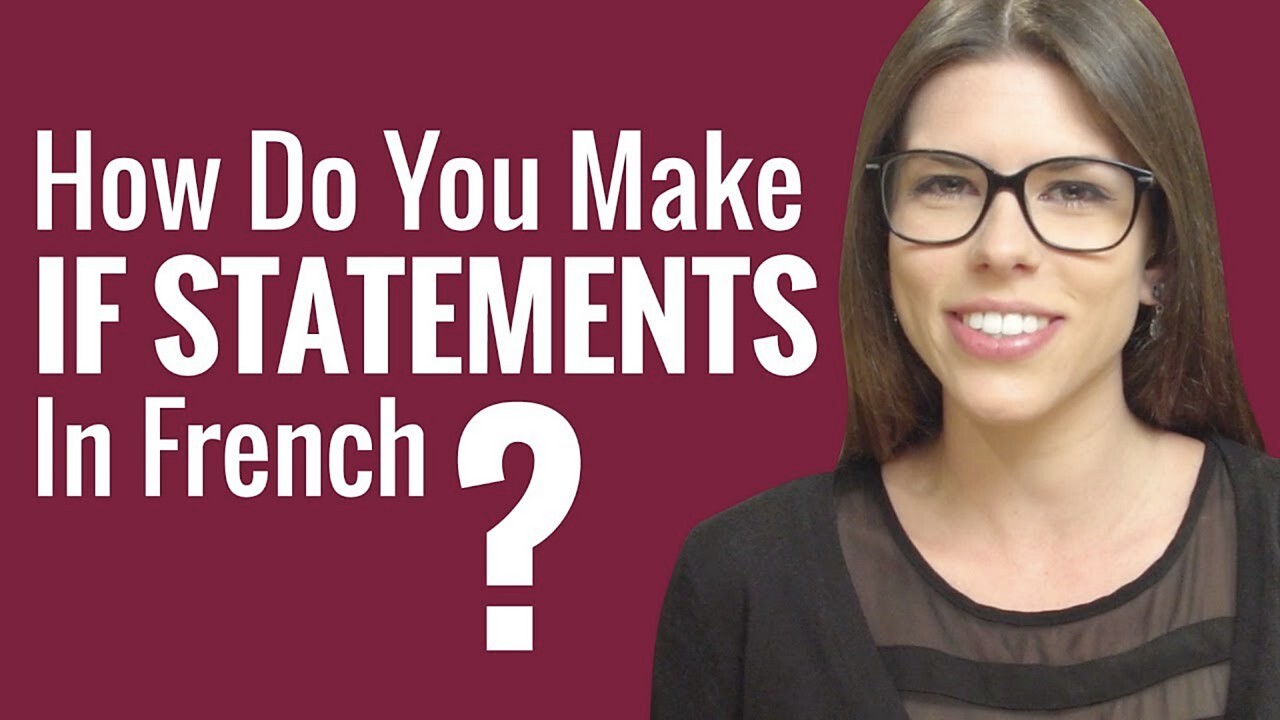
The conditional really shines in “if” sentences. In her video lesson How Do You Make If Statements in French?, FrenchPod101’s Candice explains that there are three types, depending on how likely the situation is. The conditional appears in types 2 and 3.
| Type | Si clause | Main clause | Example |
|---|---|---|---|
| 1. Likely | présent | futur | Si j’ai le temps, je t’appellerai. — If I have time, I’ll call you. |
| 2. Unlikely / imaginary | imparfait | conditionnel présent | Si j’avais le temps, je t’appellerais. — If I had time, I would call you. |
| 3. Impossible (past) | plus-que-parfait | conditionnel passé | Si j’avais eu le temps, je t’aurais appelé. — If I had had time, I would have called you. |
Candice’s own examples make the difference easy to hear:
- Type 1: Si je le vois, je dirai bonjour. — If I see him, I’ll say hello. (You might not see him, but if you do, you’ll definitely say hello.)
- Type 2: Si on pratiquait, on serait intouchables. — If we practiced, we would be unstoppable. (It isn’t true right now, but it could be.)

Type 2 is perfect for daydreaming: Si j’étais riche, j’achèterais une grande maison. (“If I were rich, I would buy a big house.”) You can also put the main clause first without changing the meaning: J’achèterais une grande maison si j’étais riche.
6. The Past Conditional (Conditionnel Passé)
To talk about what would have happened, use the conditionnel passé: avoir or être in the conditional + the past participle. Verbs that take être in the passé composé take it here too, and the participle agrees with the subject.
- J’aurais aimé venir. — I would have liked to come.
- Elle serait partie plus tôt. — She would have left earlier.
- Tu aurais dû me le dire ! — You should have told me!
The phrase j’aurais dû (“I should have”) is extremely common in everyday French, so it’s worth memorizing on its own.
7. Common Mistakes to Avoid
Everyone mixes these up at first. Here are four slips learners often make, and how to fix them.
8. Test Your French Conditional Knowledge
Ready to check what you’ve learned?
Tap an answer to see if you’re right.
Question 1. Complete the sentence: Si nous habitions à Paris, nous ___ français tous les jours. (parler)
Question 2. Which form is correct? Si j’___ plus de temps, je voyagerais.
Question 3. You’re ordering at a café in Paris. Which is the most polite?
9. French Conditional FAQ
How do you form the French conditional tense?
Take the future stem (usually the infinitive) and add the imperfect endings: -ais, -ais, -ait, -ions, -iez, -aient. For example, parler becomes je parlerais (“I would speak”).
What does “je voudrais” mean?
Je voudrais means “I would like.” It’s the conditional of vouloir (“to want”) and the standard polite way to ask for something in French, from ordering food to booking a hotel room.
Can you use the conditional after “si”?
Not when si means “if.” Use the imperfect instead. When si means “whether,” though, the conditional is fine: Je me demande s’il viendrait. (“I wonder whether he would come.”)
Is the French conditional a tense or a mood?
Traditional French grammar treats it as a mood (mode), while many modern grammars group it with the indicative tenses. Either way, you form it and use it in exactly the same way.
What does “j’aurais dû” mean?
It means “I should have.” It’s the past conditional of devoir and is often used to express regret: J’aurais dû partir plus tôt. (“I should have left earlier.”)
10. Final Thoughts
With one set of endings and a dozen irregular stems, the French conditional tense lets you order politely, give advice, share your dreams, and imagine what might have been. Start with three phrases you’ll use again and again: je voudrais, tu devrais, and si j’avais…
Your next step is to hear these forms in a real conversation, so they start to feel natural.
Practice the French conditional with Fanny
Watch Saying What You Want in French and learn to use je voudrais with confidence.
Watch the French LessonWhat would you do if you lived in France? Answer in French using the conditional in the comments!